Black Holes & Wormholes
Explore the mysteries of spacetime, gravitational singularities, and cosmic shortcuts
HOMEWhat is a Black Hole?
A black hole is a region of spacetime where gravity is so strong that nothing—no particles or even electromagnetic radiation such as light—can escape from it. The theory of general relativity predicts that a sufficiently compact mass can deform spacetime to form a black hole.
Black Hole Visualization
Click or hover to see effects
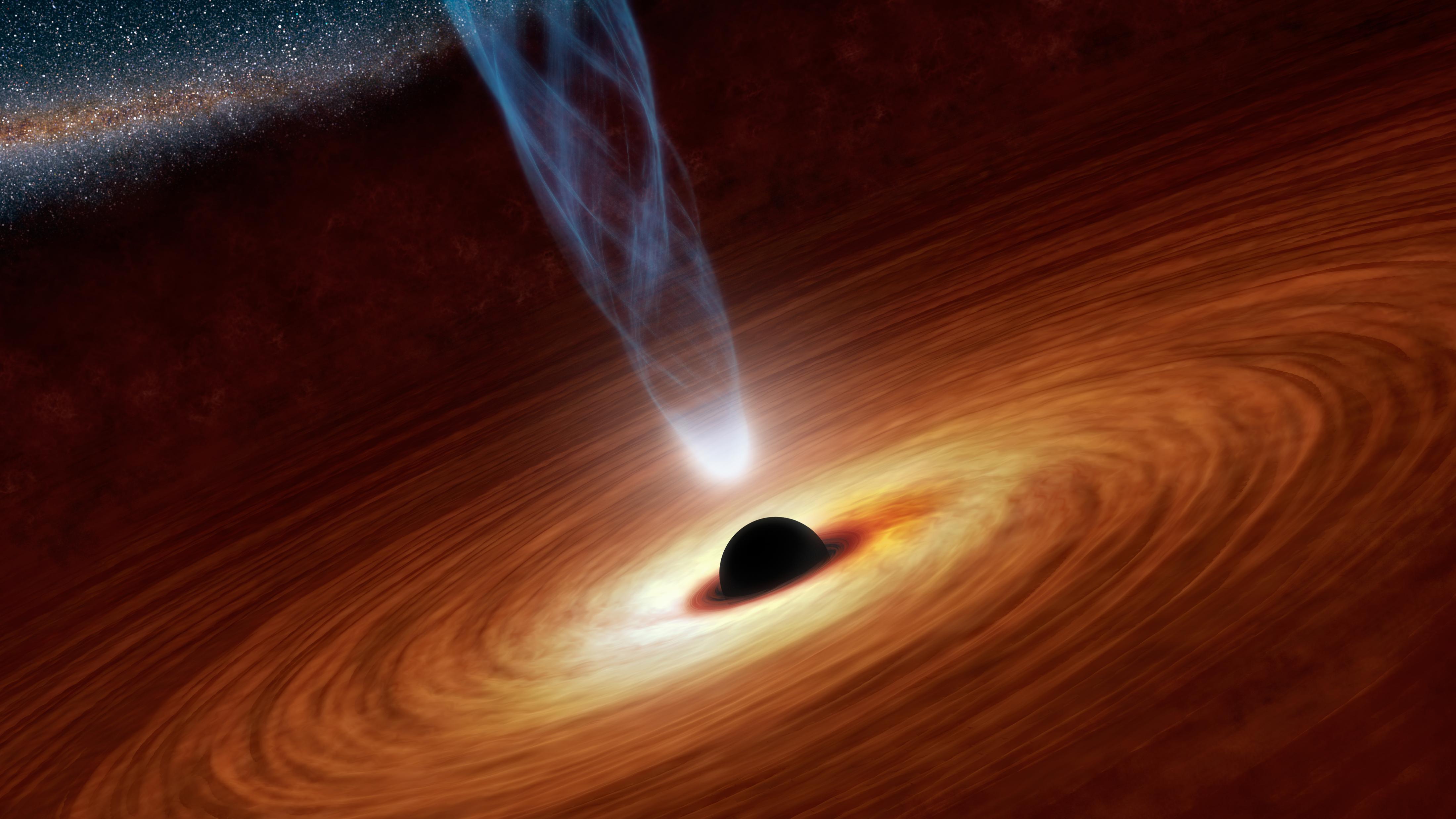
Artist's depiction of a black hole with accretion disk
Key Characteristics
- Event Horizon: The boundary beyond which nothing can escape
- Singularity: The infinitely dense core at the center
- Accretion Disk: Superheated matter spiraling into the black hole
- Gravitational Lens: Light bending around the black hole
Supernovae: Stellar Explosions
Supernovae are powerful explosions that mark the death of massive stars. These cosmic events can outshine entire galaxies and are responsible for creating many of the elements found in the universe, including those necessary for life.
Supernova Simulation
Click to trigger supernova explosion
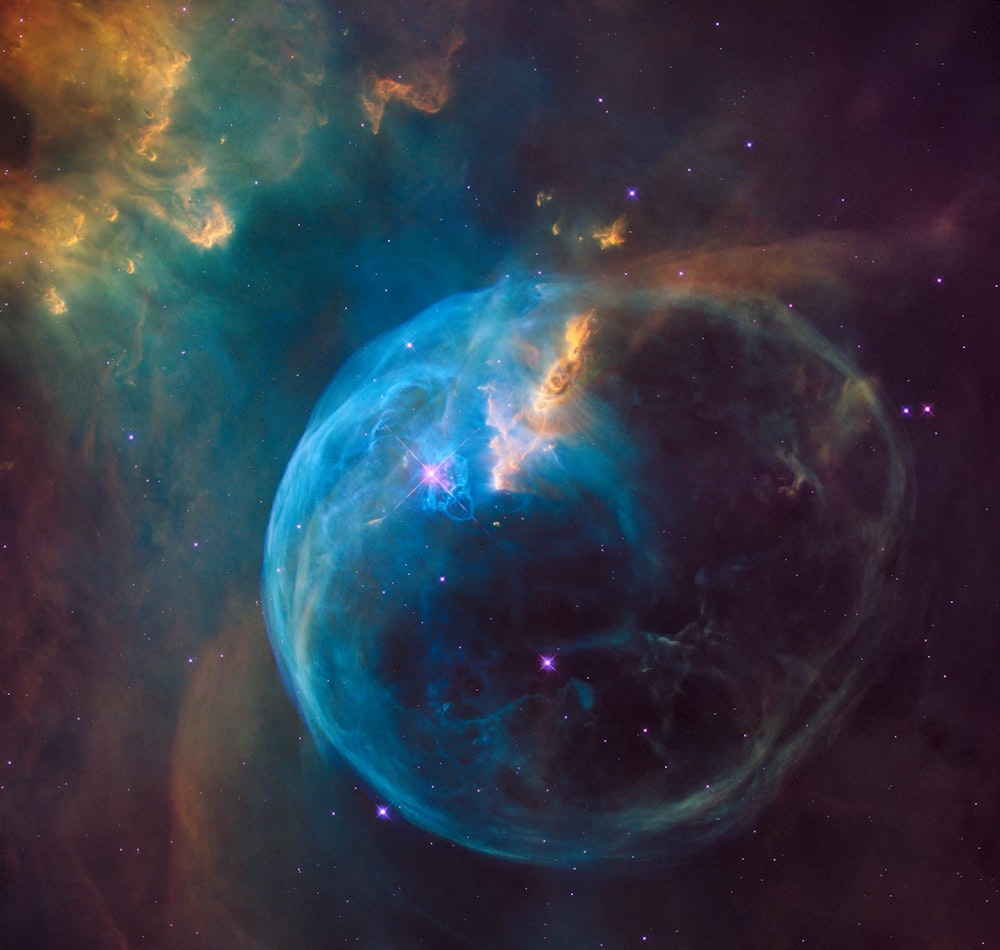
Crab Nebula - remnant of a supernova observed in 1054 AD
Types of Supernovae
- Type Ia: Occurs in binary systems when a white dwarf accumulates too much mass
- Type II: Results from the collapse of a massive star's core
- Hypernova: Extremely energetic supernova that may produce gamma-ray bursts
Connection to Black Holes
When massive stars (at least 20-30 times the mass of our Sun) explode as supernovae, their cores can collapse to form black holes if the remaining mass is sufficient.
Event Horizon & Hawking Radiation
The event horizon is the boundary around a black hole beyond which nothing can escape. Stephen Hawking theorized that black holes aren't completely black but emit radiation due to quantum effects near the event horizon.
Hawking Radiation
Virtual particle pairs form near the event horizon
First image of a black hole's event horizon by the Event Horizon Telescope
Hawking Radiation Process
- Virtual particle pairs constantly form and annihilate throughout space
- Near the event horizon, one particle may fall in while the other escapes
- The escaped particle becomes real, carrying energy away from the black hole
- This causes the black hole to slowly lose mass and eventually evaporate
Black Hole Information Paradox
Hawking radiation creates a paradox: if black holes evaporate, what happens to the information about what fell into them? This remains one of the biggest unsolved problems in theoretical physics.
Gravitational Waves
Gravitational waves are ripples in the fabric of spacetime caused by some of the most violent and energetic processes in the Universe. They were first detected in 2015 by the LIGO observatory, confirming a key prediction of Einstein's general theory of relativity.
Gravitational Wave Simulation
Click to simulate merging black holes
LIGO observatory used to detect gravitational waves
Sources of Gravitational Waves
- Binary neutron star systems
- Black hole mergers
- Supernovae explosions
- Cosmic inflation in the early universe
Detection Methods
Gravitational waves are detected using extremely sensitive instruments like LIGO and Virgo, which use laser interferometry to measure tiny distortions in spacetime as waves pass through Earth.
Inside a Black Hole
The interior of a black hole is one of the greatest mysteries in physics. According to general relativity, at the center of a black hole lies a gravitational singularity, a region where the spacetime curvature becomes infinite.
Spaghettification Simulation
Click the button to simulate spaghettification

Visualization of spaghettification near a black hole
What Happens Inside?
- Spaghettification: Extreme tidal forces stretch objects into long, thin shapes
- Time Dilation: Time passes much slower near the event horizon
- Information Paradox: What happens to information that falls into a black hole?
- Hawking Radiation: Theoretical radiation that may cause black holes to evaporate
Wormholes: Cosmic Shortcuts
A wormhole is a hypothetical topological feature of spacetime that would be a shortcut through spacetime. Much like a tunnel with two ends, each in separate points in spacetime, wormholes are consistent with the general theory of relativity.
Wormhole Visualization
Hover to activate the wormhole
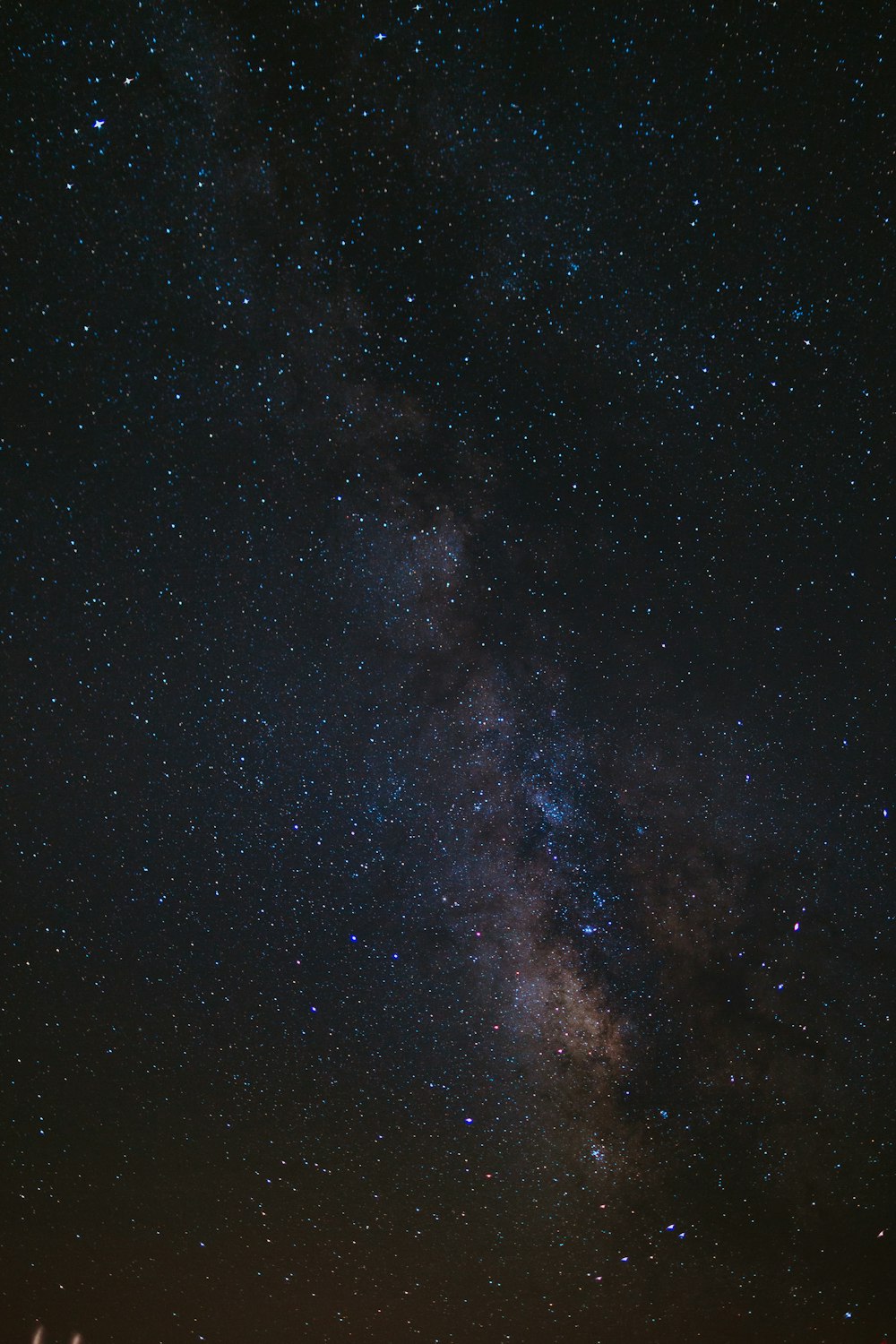
Artist's concept of a traversable wormhole
Types of Wormholes
- Einstein-Rosen Bridges: The original theoretical concept
- Traversable Wormholes: Hypothetical wormholes that could be crossed
- Quantum Wormholes: Microscopic wormholes at the quantum level
- Interstellar Wormholes: Popular in science fiction for space travel
White Holes: Theoretical Opposites
White holes are hypothetical regions of spacetime that cannot be entered from the outside, although matter and light can escape from them. In this sense, they are the reverse of black holes, which can be entered from the outside but from which nothing can escape.
White Hole Visualization
White holes emit matter and energy
Conceptual visualization of a white hole
Properties of White Holes
- They are the time-reversed version of black holes
- Nothing can enter a white hole from the outside
- They emit matter and radiation
- Their existence is purely theoretical and not yet observed
Connection to Wormholes
Some theories suggest that a black hole in one universe could be connected to a white hole in another universe through a wormhole, creating an Einstein-Rosen bridge.
Time Dilation Near Black Holes
According to Einstein's theory of general relativity, time passes at different rates in regions of different gravitational potential. Near a black hole, where gravity is extremely strong, time passes much more slowly compared to regions with weaker gravity.
Time Dilation Comparison
Notice how time passes slower near the black hole
Visual representation of gravitational time dilation
Understanding Time Dilation
Time dilation occurs because massive objects like black holes warp the fabric of spacetime. The closer you are to a massive object, the slower time passes for you relative to observers further away.
Real-World Implications
- GPS satellites must account for time dilation effects to maintain accuracy
- An astronaut near a black hole would age slower than people on Earth
- This effect is demonstrated in movies like Interstellar
Cosmic Scale Comparison
Black holes and other cosmic objects come in vastly different sizes. Understanding their scale helps put these incredible phenomena into perspective.
Size Comparison
Relative sizes of cosmic objects (not to actual scale)

Visualization of cosmic scales from planets to galaxies
Types of Black Holes by Size
- Primordial: Hypothetical tiny black holes formed in the early universe
- Stellar: Formed from collapsing stars, 5-100 times the mass of our Sun
- Intermediate: Between stellar and supermassive, 100-100,000 solar masses
- Supermassive: Millions to billions of solar masses, found at galaxy centers
Notable Black Holes
- Cygnus X-1: First stellar black hole discovered
- Sagittarius A*: Supermassive black hole at our galaxy's center
- M87*: First black hole ever imaged
- TON 618: One of the most massive known black holes
Sci-Fi Connections
Black holes and wormholes have captured the imagination of science fiction writers and filmmakers for decades. While often taking creative liberties, these depictions sometimes reflect real scientific concepts.
Interstellar's Gargantua
Hollywood's depiction of a black hole
Gargantua from the movie Interstellar
Notable Sci-Fi Depictions
- Interstellar (2014): Featured a scientifically accurate black hole visualization created with help from physicist Kip Thorne
- Event Horizon (1997): A spaceship that creates an artificial black hole as a gateway to another dimension
- Star Trek: Frequently uses wormholes as plot devices for travel across vast distances
- Stargate: Features an ancient network of wormholes connecting different planets
Science vs. Fiction
While science fiction often takes creative liberties, it has sometimes inspired real scientific inquiry. The visual effects team for Interstellar actually published scientific papers based on their realistic rendering of a black hole.
Interactive Quiz
Test your knowledge about black holes, wormholes, and related cosmic phenomena with this interactive quiz!
Question 1: What is the boundary around a black hole from which nothing can escape?
Question 2: What theoretical process causes black holes to slowly lose mass?
Question 3: What are ripples in spacetime caused by massive accelerating objects?
Question 4: What is the term for the stretching of objects by extreme tidal forces near a black hole?
Black Hole Simulation
Drop objects into the black hole and observe what happens! Objects will automatically move toward the black hole due to its gravitational pull.
Fun Facts About Black Holes & Wormholes
Black holes and wormholes are fascinating concepts that challenge our understanding of the universe. Click the button below to reveal random facts about these cosmic phenomena.